
Endpoint adjudication sits directly on your trial’s critical path. Judi replaces email, spreadsheets and shared drives with a structured, auditable workflow that speeds up cycle times and minimizes data queries. By keeping adjudication moving forward, Judi protects your database lock and keeps interim reviews on track. Every step builds a timestamped audit trail so you are always inspection-ready.

Risk develops when sponsors, CROs, AROs and committees work piecemeal across email, spreadsheets and shared drives. These manual handoffs fragment your timelines, introduce operational silos and degrade decision quality. The entire effort becomes untraceable and hard to defend.

Less processing time per case
Decided on the first dossier
Lower CEC fees per case
Based on a CRO partner’s time-in-motion analysis across 100+ adjudication projects.


No more manual triage. Concordant cases close automatically. Discordance is flagged and immediately routed to the next step for true arbitration, removing critical wait times between process steps.

Monitor performance to spot operational trends and prevent bottlenecks before milestones slip. Real-time reports and dashboards track workloads, case status, cycle times and committee performance to give you the operational KPIs needed to act in time.

The audit trail builds itself. Every action, handoff and committee determination is timestamped as it happens, with the decision logic attached. Where AI assists, the record shows what it proposed and who approved it.
Configure endpoint intake, case processing, review phases and committee structures to your charter.

Bring essential data into Judi from EDC, CTMS and ePRO. No duplicate entry, no toggling between systems.

Create, edit, e-sign and share Word, Excel and PPT in Judi. Use it for charters and notes to file.

Route endpoints through case processing, QC, Phase 1 adjudication and Phase 2 resolution, with no lag.

Non-English source docs translated inline through our TransPerfect integration. No manual exchange.

AI finds all protocol-defined PHI, with human review confirming every redaction.

Upload, de-identify and submit medical images with endpoint dossiers when required.

Phase 2 reviewers compare Phase 1 discordant outcome forms side by side, for greater precision.

Access is gated by role and workflow state. Queries and role-to-role discussions stay in the audit trail.

Monitor workloads, case status, cycle times and committee performance in real time.

Every action, handoff and committee determination timestamped with its decision logic, as it happens.
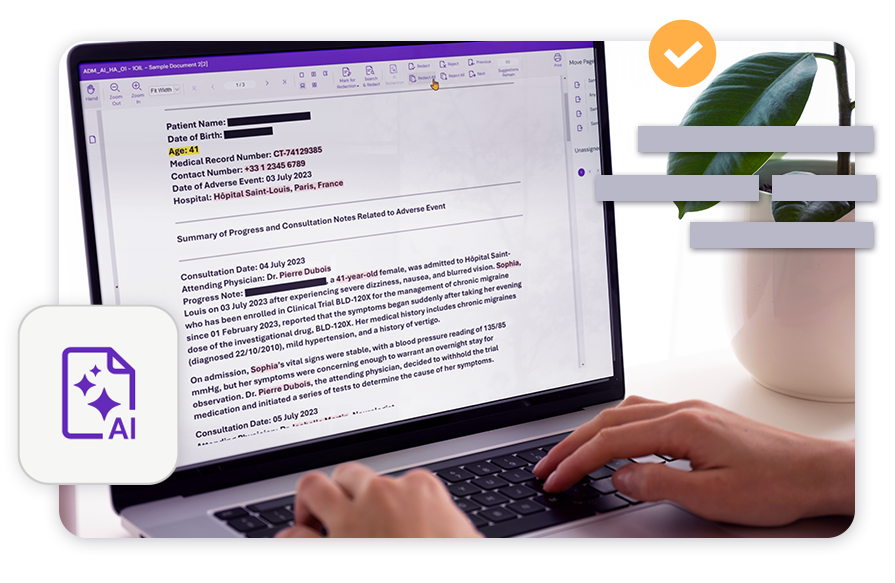
Manually redacting PHI is one of the most time-consuming and error-prone tasks in patient record handling. In adjudication it’s also a gate. Nothing reaches your committee until every identifier is masked, so every case waits on it. Judi’s native AI-assisted redaction tool reads every document and flags each suspected identifier for action, so PHI never sits exposed in a case file and redaction never holds adjudication up.
Your committee has a charter. Your AI needs one too. A charter sets what’s in scope, who signs off and how every determination is documented. Judi holds AI to those same three things, whatever models you use, whether it’s Judi’s or your own. When a regulator asks about an AI-assisted step, the record shows what AI proposed, who reviewed it and what they decided.

A Clinical Endpoint Committee (CEC) is a small panel of independent, unbiased, blinded experts charged with centralized review and decision-making about clinical events that are being assessed as protocol endpoints for efficacy or safety analysis. This review process is known as endpoint adjudication, and its objective is to provide a normalized dataset of endpoint outcomes for statistical analysis. Because those determinations become the endpoint data in your submission, how the committee reached them is part of the regulatory record.
Judi is a clinical trial optimization platform that supports adjudication end to end: endpoint intake, case processing, endpoint dossier submission, adjudicator decision-making, endpoint outcome forms, a comprehensive set of real-time reporting tools, and a full audit trail. The committee’s workflow is configured to your trial specification, with role-based forms and independence enforced at the form level.
There is no difference in the remit or scope of these committees. The terms are interchangeable. Each describes an independent group of clinical experts who apply predefined protocol criteria to reported trial events and determine which qualify as endpoints. You will also see Clinical Adjudication Committee (CAC), Independent Adjudication Committee (IAC) and simply Adjudication Committee (AC). Most shorten to CEC. What separates one committee from another is not the name but the charter: which events it reviews, what criteria it applies, how many adjudicators see each case and how disagreements are resolved. Judi configures to the charter, whatever the committee is called.
There is no regulatory mandate for endpoint adjudication. What determines the need is whether the study protocol includes subjective efficacy or safety endpoints. Objective endpoints, such as a lab value or a reproducible measurement, can be classified without complex medical judgment and do not require adjudication. Subjective endpoints, such as death, stroke or myocardial infarction, depend on clinical judgment, and subjective decision-making leads to data variability. To control for that variability, an adjudication committee consistently applies protocol-specific endpoint criteria to each clinical event and determines which ones should be counted as study endpoints. Adjudicated outcomes are essential to garner credibility with regulators for claims of efficacy or safety that are based on the analysis of clinical events. No industry standard governs how the process is run, so its design is yours to get right.
FDA and EMA do not use a method to audit adjudication data that differs from their overall audit and inspection practices. Procedurally, regulators expect documented procedures for every clinical trial process, evidence that training was completed before individuals carried those procedures out, and clear documentation that the procedures were followed without exception. Where exceptions do occur, they expect documentation that fully addresses the root cause along with any corrective or preventive actions taken. For trial data specifically, they expect to verify system compliance and to review a full audit trail for the data housed in those systems.
Judi is SOC 2 Type 2 certified and validated to support your 21 CFR Part 11, HIPAA and GDPR obligations. Its audit trail documents procedural, system and data compliance completely and automatically, so your teams are continually audit and inspection ready.
No. Adjudication exists because subjective endpoints require clinical judgment, and the determination has to belong to a qualified, independent expert. AI can do the work around that judgment. In Judi, AI assists with PHI redaction, reading every document and flagging each suspected identifier for human approval. Every AI output lands where a person reviews it and makes the call, and the record shows what AI proposed, who reviewed it and what they decided.
When two adjudicators disagree, Judi flags the case automatically and routes it for resolution according to your charter, most commonly to the Committee Chair or to the full committee. No manual triage, and no third blind tiebreaker. The case is identified as discordant, so the reviewer knows to look for the root cause of the disagreement rather than simply casting another vote. That is true arbitration, and it produces better endpoint data than a majority-wins approach. The rationale is captured with the determination, in the same audit trail.
Judi supports whatever model your charter defines. The two most common among our clients are parallel adjudication and paired consensus adjudication. In both, two adjudicators review each case independently. Judi closes concordant cases automatically and routes discordant cases for final determination with no manual triage. The models differ at that escalation: parallel adjudication routes to the Committee Chair, and paired consensus adjudication routes to the full committee for consensus review.
Judi expedites endpoint case processing by removing the two things that slow dossiers down: scattered handoffs and manual redaction. Sites work directly in Judi and collaborate in real time with case processors to prepare accurate, focused and complete dossiers. Using one unified workspace for endpoint intake, source document collection, query management, case processing, QC and dossier compilation removes the friction and long lag times that come from manual handoffs scattered across email and SharePoint.
Judi also has built-in efficiencies that reduce manual effort significantly and let sites and case processors focus on higher-value work: automatic tracking and case routing, automatic reminders with due dates for actions, AI-assisted PHI redaction, automated document routing with integrated translation, and automatic dossier compilation. Best practice on collection is a site checklist per endpoint type, covering the minimal set of records that speak to the criteria the committee has to assess. Most cases close against the checklist, and only the outliers require case-specific collection.
Yes, Judi can support any and all clinical trial workflows, each configured to the protocol and project plans it serves, on one validated platform. Most trials run eligibility, imaging, DSMB, remote source data verification and adjudication. Also running today: user qualification, IRB, screening coordination, document development, 24/7 medical monitoring, clinical safety, protocol deviations and steering committee. We continually roll out new workflows. Need a workflow that isn’t here? If you can draw it, we can build it.
Yes. Judi is SOC 2 Type 2 certified and holds active certification under the EU-U.S. Data Privacy Framework, including the UK Extension and the Swiss-U.S. DPF. The SOC 2 examination is an independent CPA review of the design and operating effectiveness of our security controls, performed every year since 2021, with no exceptions noted in the most recent report. Judi operates as a data processor and business associate on behalf of sponsors and CROs, and is designed and validated to support your 21 CFR Part 11, HIPAA and GDPR obligations, covering electronic records and signatures, audit trails and access controls. Trial data is collected, processed and reviewed in a validated, access-controlled platform, with every action captured in a timestamped audit trail. AG Mednet supports client security questionnaires, vendor assessments and audits as part of standard engagement, and can share evidence on request.
The recommended adjudicator workflow models in Judi are based on best practice, and both are built on quality by design. At Phase 1, both models involve independent review of each case by two adjudicators who do not discuss the case and are unaware of each other’s decisions. At Phase 2 the models look different, but both incorporate a principle known as true arbitration: when there is discordance at Phase 1, the party performing disagreement resolution has the benefit of discernment. Whether that is the Committee Chair in the parallel model or the full committee in the consensus model, the parties making the final decision know the case is a disagreement and can see the specific areas of discordance that arose at Phase 1. That perspective lets them identify the root cause and determine a reasoned final outcome based on the insight.