
Run secure meetings by enforcing strict blinding rules through system-level permissions. Judi protects board independence and data confidentiality, ensuring the right people access the right sessions. Simplify manual coordination and reduce administrative burden on your team. From automated report packaging to secure minutes, built-in guardrails keep your process compliant to safely unlock expert recommendations.
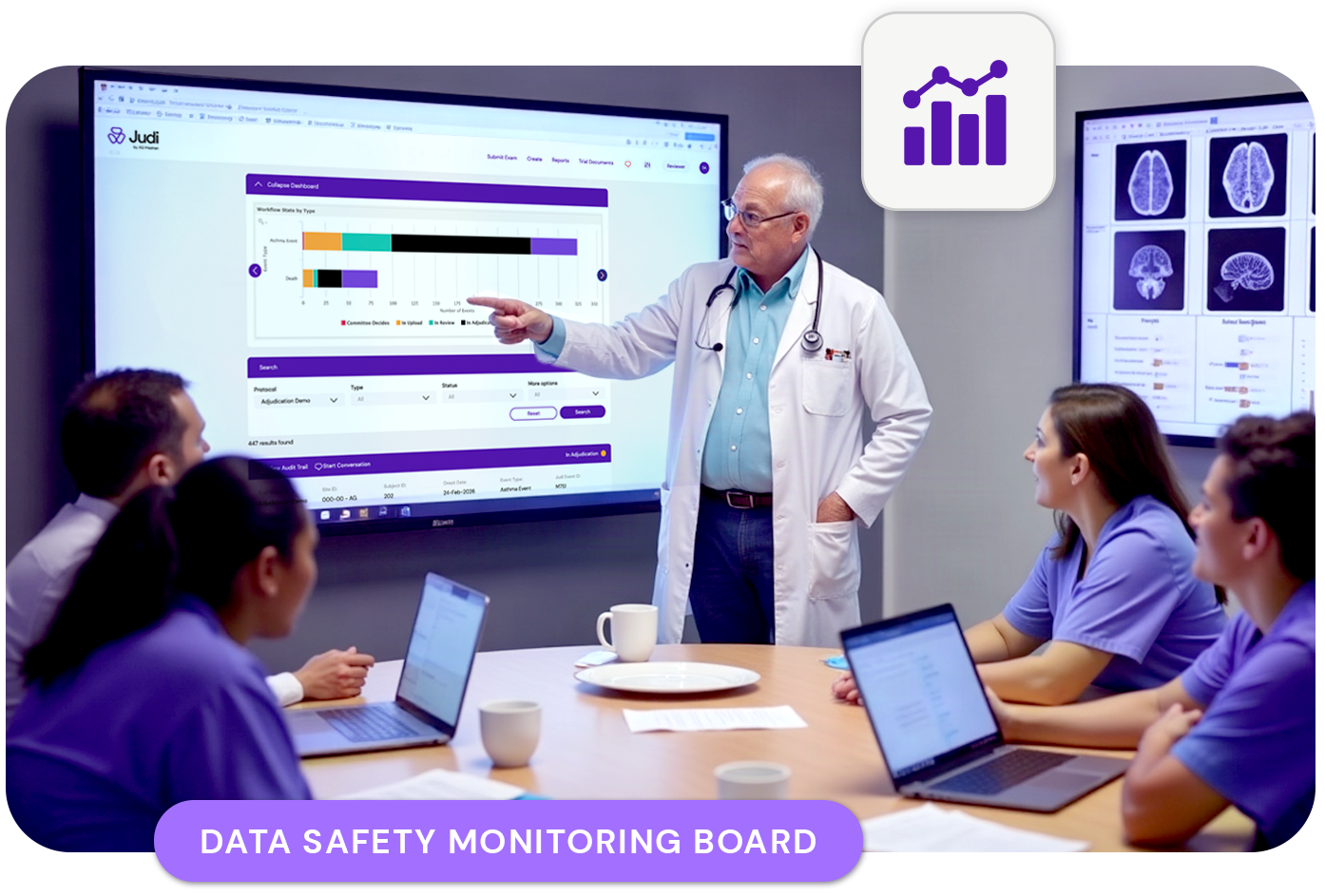
A Data Safety Monitoring Board (DSMB), or Data Monitoring Committee (DMC), is a panel of experts that periodically reviews a trial’s accumulating, unblinded safety and efficacy data to protect patient safety and scientific data integrity. Judi manages the entire DSMB process in one place, from distributing blinded and unblinded reports and managing meetings to capturing recommendations and minutes. Every action is timestamped on a complete audit trail, while unblinded data remains securely separated from the blinded trial team.
In its 2024 draft guidance on data monitoring committees, the FDA strongly recommends an independent DMC when patients are vulnerable or at risk of serious harm. Independence means members are free of significant conflicts of interest, financial, ethical, scientific or otherwise, and that they deliberate in private sessions without the sponsor or study team.
The guidance also calls for the board to review unblinded safety and unblinded comparative efficacy data together, not blinded safety data in isolation. Only then can it weigh a safety signal against the benefit, or see clear futility.
Judi holds those boundaries. Independence assessments are documented, decision-making follows a compliant workflow and unblinded data reaches only the people cleared for it.

A DSMB includes stakeholders with different data access permissions. Some can see unblinded data, others must not. Managing that across email, spreadsheets, shared drives and sFTP servers is heavy manual work, and the mistakes it invites cannot be undone.
Blinded and unblinded reports reach only the intended people, so the study blind is strictly maintained, preventing data breaches that lead to operational and assessment bias and threaten regulatory acceptance.
The board gets the trial data it needs it, when it it needs it, so risks to patients and scientific integrity surface early and oversight keeps pace with trial needs.
Scheduling, reports, meetings, minutes and recommendations stay in one workflow. Sponsor, CRO, ARO and board work in the same place, partitioned so each sees only what their role allows. Every action captured, on the record, as it happens.

Configure scheduling, material distribution, session format and recommendation forms to meet charter requirements.

Create, edit, finalize, e-sign and share Word, Excel and PPT inside Judi. Use it for charters, agendas, minutes and recommendation letters.

Collect availability, send automatic reminders and let Judi compare responses to identify times that work for everyone.
Deliver report packages with audit trail timestamps, so you can prove who received what and when. Blinded and unblinded reports reach only their intended readers.
Run every session of a data review meeting in one place, access limited to cleared participants, so the board moves from open to private and back with the blind protected.

With Microsoft 365 built in, designated attendees create and finalize minutes live, before the session ends. No post-meeting drafting, no circulating by email.
Keep reference documents such as charters, protocols and IBs in one place. Everyone works from the latest version, with role-based access.
Dashboards show meeting metrics, document status and committee performance. Confirm reports were submitted and minutes finalized without opening what you can’t see.
Every action, handoff and committee recommendation timestamped and attributed as it happens. The record builds itself.
A Data Safety Monitoring Board (DSMB) is an independent committee that reviews a trial’s accumulating safety and efficacy data while the study is still running, to protect the patients in the trial and keep the results credible. It is made up of experts from outside the trial, usually clinicians and a biostatistician, who meet at set points to recommend whether the trial should continue, change or stop.
There is no practical difference. Data Safety Monitoring Board (DSMB), Data Monitoring Committee (DMC) and Independent Data Monitoring Committee (IDMC) are different names for the same independent committee that reviews a trial’s accumulating safety data.
For most trials a DSMB is recommended, not required. Under FDA regulations, an independent DSMB is required only for emergency research where informed consent requirements are waived (21 CFR 50.24). Otherwise the decision sits with the sponsor and is driven by risk, not trial size. FDA’s 2024 draft guidance strongly recommends a DSMB when trial patients face a risk of serious harm, such as serious illness or death, and DSMBs are also common for vulnerable populations, large or long multi-center trials, and trials using an adaptive design. The guidance notes increased use of DMCs in trials of modest size. Most DSMBs are found in Phase 2 and Phase 3 studies.
The charter is the document that governs how the board operates. It typically sets membership and quorum, the meeting schedule and format, what data the board reviews and in what form, who prepares the reports and who may access them, how reports are stored and transmitted, conflict-of-interest requirements, and the procedures for making recommendations and for adding or removing members. FDA’s 2024 draft guidance treats the charter as a detailed operating document. It is also the reference Judi is configured against: permissions follow what the charter says.
A DSMB’s recommendations are advisory. The sponsor holds the decision and is accountable for acting on it, and FDA guidance addresses sponsor interaction with the agency around early termination. A sponsor that disagrees with a recommendation to stop would normally return to the board with additional data rather than proceed against it.
The unblinded interim data stays with the people the charter clears for it and does not reach the sponsor, investigators or trial team. In Judi, that separation is built into the platform: permissions follow your charter, so unblinded data reaches only the people it clears, and never a blinded role. Every access is recorded, so you can prove the blind held.
Judi coordinates the meeting from end to end: scheduling the board, assembling and distributing blinded and unblinded reports, hosting the open and closed sessions, and capturing minutes and the board’s recommendation. Every step follows your charter’s permissions, and every action is recorded, so the record stays complete.
Yes. Judi is SOC 2 Type 2 certified and holds active certification under the EU-U.S. Data Privacy Framework, including the UK Extension and the Swiss-U.S. DPF. The SOC 2 examination is an independent CPA review of the design and operating effectiveness of our security controls, performed every year since 2021, with no exceptions noted in the most recent report. Judi operates as a data processor and business associate on behalf of sponsors and CROs, and is designed and validated to support your 21 CFR Part 11, HIPAA and GDPR obligations, covering electronic records and signatures, audit trails and access controls. DSMB data is collected, stored and reviewed in a validated, access-controlled platform, with every action captured in a timestamped audit trail. AG Mednet supports client security questionnaires, vendor assessments and audits as part of standard engagement, and can share evidence on request.
Yes. Judi can support any and all clinical trial workflows, each configured to the protocol and project plans it serves, on one validated platform. Most trials run eligibility, imaging, DSMB, remote source data verification and adjudication. Also running today: user qualification, IRB, screening coordination, document development, 24/7 medical monitoring, clinical safety, protocol deviations and steering committee. We continually roll out new workflows. Need a workflow that isn’t here? If you can draw it, we can build it.