
Judi ensures only qualified patients enroll, with every decision fully documented and inspection-ready. Decisions come back in days, not weeks. Protect patient safety, preserve data integrity and defend every enrollment decision.
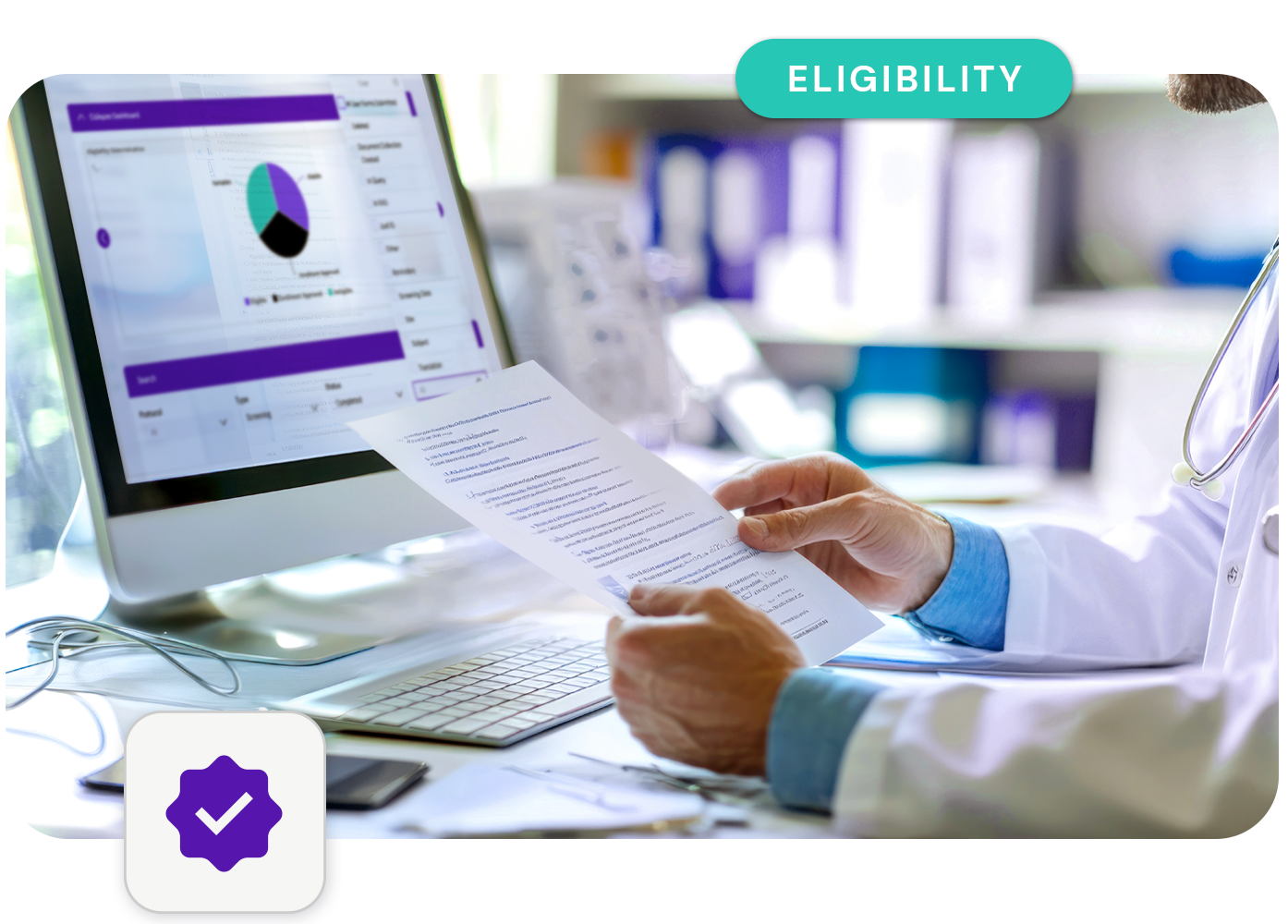
Centralized eligibility review is a process where designated medical reviewers apply a trial’s protocol inclusion and exclusion criteria the same way to every subject in screening. This approach provides consistency and enhances protocol compliance, instead of leaving these decisions to site-by-site interpretation. Each centralized decision is captured with its rationale and supporting evidence. The payoff is consistent eligibility decisions, elimination of enrollment-based protocol deviations and a complete, inspection-ready record. Judi is the platform centralized eligibility review runs on. Preventing incorrect enrollment is an essential quality-driven process that protects patient safety, preserves data integrity and promotes regulatory acceptance.
FDA’s December 2024 draft guidance on protocol deviations specifically calls out incorrect enrollment as a serious or “important” reportable deviation. It asks sponsors to build quality in from the start, to prevent them by design. Centralized eligibility review is a practical, proven way to do exactly that.


Risk develops when every site applies its own judgment instead of one shared process. Subjective or complex criteria are particularly prone to variable interpretation. Enrollment pressure can bias borderline calls. This is how incorrect enrollment happens, protocol deviations stack up, safety risk rises, trial integrity erodes and regulatory acceptance is jeopardized.
Judi routes every enrollment request to a designated reviewer using the same standardized package. This ensures reliable compliance with protocol inclusion and exclusion criteria every time.
Enrollment requests advance automatically through a single-reviewer assessment process. This streamlined workflow enables rapid, fit-for-purpose decisions.
Configure request, review and determination workflows to meet protocol requirements.

Sites and case processors build the eligibility package together, with automated tracking and due dates.

Connect directly with systems like EDC, CTMS, ePRO and labs via open API.

Create, edit, e-sign and share Word, Excel and PPT within Judi, every edit logged.

Route eligibility packages through case processing, QC and medical review, with no lag.

Non-English source docs translated inline through our TransPerfect integration.

Upload, de-identify and submit medical images for eligibility decisions when required.
Missing or unclear documents are requested and tracked in Judi so enrollment doesn’t stall.

Single step, single reviewer. Decisions come on a rolling basis, with no scheduled meetings.

Access is gated by role and workflow state. Queries and role-to-role discussions stay in the audit trail.
Monitor request status, cycle times and reviewer performance in real time.
Every action, handoff and determination timestamped as it happens. Nothing to reconstruct.

Gain complete oversight across the entire eligibility-to-enrollment process. Judi unifies sites, sponsors, CROs, AROs and labs on a single platform, replacing fragmented, site-by-site decisions with one standard. This central workflow keeps decisions moving, giving everyone real-time visibility into screening and enrollment status, pending actions and file completeness from day one.
Teams using Judi reach a two-day median total cycle time from enrollment request to final decision. The workflow is streamlined, with automation and AI tools that cut effort and lag time. Each screening routes to the designated reviewer as it arrives, with real-time review status throughout. Nothing batched, nothing piling up in email, spreadsheets or shared drives. The delay that costs you comes later, replacing an incorrectly enrolled patient and holding up database lock.

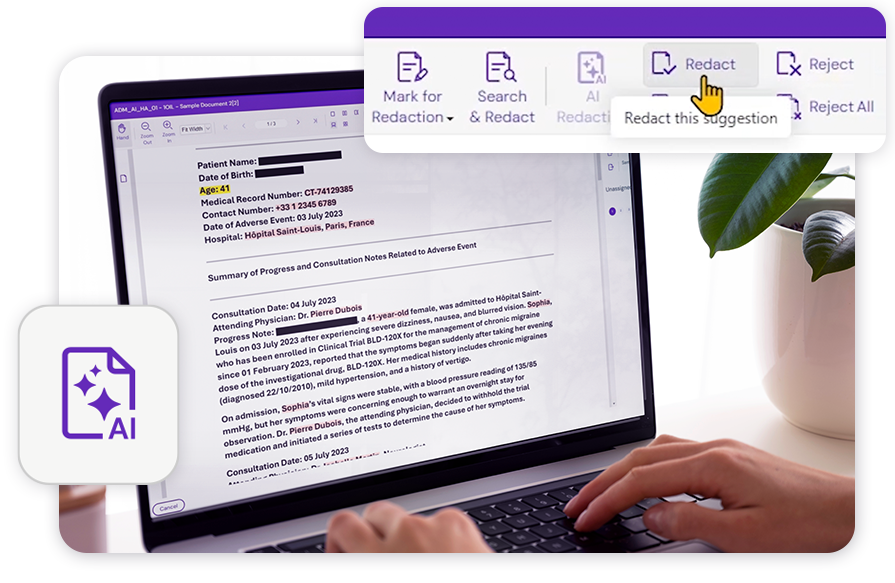
Manually redacting PHI is one of the most time-consuming and error-prone tasks in patient record handling. In eligibility it’s also a gate. Nothing reaches your medical reviewer until every identifier is masked, so every case waits on it. Judi’s native AI-assisted redaction tool reads every document and flags each suspected identifier for action, so PHI never sits exposed in a case file and redaction never holds up an enrollment decision.
Judi governs every AI model running in your trial: ours, yours and any third party you add. Each one is a participant in the workflow with a defined role and defined permissions, just like any member of the team. It acts only where the workflow allows, its work goes to a named person before anything moves and every action lands in the same audit trail as everyone else’s. One place to govern all of it, so every output is traceable and every decision defensible.

Centralized eligibility review is a structured process where protocol inclusion and exclusion criteria are applied the same way to every patient by designated medical reviewers, rather than left to site-by-site interpretation. Every determination is captured with its rationale in an auditable record.
It adds the most value when criteria are lengthy, complex or subjective. For a shorter set of simple, objective rules such as positive or negative labs or use of concomitant medications, a centralized review process may not be necessary.
Setting it up while you are drafting the protocol and defining the eligibility criteria is ideal. That is quality by design, building the controls in from the start. It can be added mid-study or applied retrospectively as a corrective measure, but reconstructing eligibility evidence months after a patient is enrolled is far harder than capturing and reviewing it as you go.
Yes. FDA’s December 2024 draft guidance on protocol deviations names incorrect enrollment as a serious, “important” reportable deviation and asks sponsors to prevent it by design. There is global regulatory consensus on the critical need to prevent incorrect enrollment. Centralized eligibility review does that by applying inclusion and exclusion criteria consistently before a patient is enrolled.
Judi runs the entire eligibility workflow in one governed place. Sites submit documentation, the case processing team prepares and redacts the eligibility package, a single medical reviewer makes the determination. All actions and decisions with decision logic are captured in a complete audit trail.
Judi workflows are flexible and can be configured to meet the requirements of your charter. The most common model utilized by our clients is a single reviewer model. Reviewers can be sponsor, CRO or ARO medical staff or external independent experts, matched to the study’s risk.
This is currently a topic of conversation at a lot of tables. Judi is the enterprise home for intelligent clinical trial operations. We deploy artificial intelligence according to an industry best practice playbook, and AI is governed in part through human-in-the-loop oversight.
The strategy we are considering is to support AI-assisted eligibility decision-making. This approach would involve using AI to scan eligibility dossiers to identify and highlight evidence of the targeted inclusion and exclusion criteria that are documented in the eligibility charter. Under this approach, the AI tool would not make a medical judgment; instead it would present these results to human eligibility reviewers for a final decision. In this manner, AI would bring efficiency, speed, scale and clarity to human eligibility reviewers, and humans would still own the decision.
Eligibility documents are collected, redacted and reviewed in a validated, access-controlled platform.
Judi is SOC 2 Type 2 certified and holds active certification under the EU-U.S. Data Privacy Framework, including the UK Extension and the Swiss-U.S. DPF. The SOC 2 examination is an independent CPA review of the design and operating effectiveness of our security controls, performed every year since 2021, with no exceptions noted in the most recent report. Judi operates as a data processor and business associate on behalf of sponsors and CROs, and is designed and validated to support your 21 CFR Part 11, HIPAA and GDPR obligations, covering electronic records and signatures, audit trails and access controls. Eligibility documents are collected, redacted and reviewed in a validated, access-controlled platform, with every action captured in a timestamped audit trail. AG Mednet supports client security questionnaires, vendor assessments and audits as part of standard engagement, and can share evidence on request.
Sites work directly in Judi and collaborate in real time with case processors to prepare accurate, focused and complete eligibility packages. Using one unified workspace for enrollment requests, source document collection, query management, case processing, QC and packet compilation removes the friction and long lag times that come from manual handoffs that tend to scatter across email and SharePoint.
Judi also has built-in efficiencies that significantly reduce manual effort and allow sites and case processors to focus on higher-value work. Automatic tracking and case routing. Automatic reminders with due dates for actions. AI-assisted PHI redaction. Automated document routing with translation integration. Automatic packet compilation. The platform does the heavy lifting so your team doesn’t have to.
Yes. Judi runs Site Qualification, Eligibility, Imaging, DSMB, Remote SDV and Adjudication workflows, and it is configured to each one. Sponsors and CROs that start with eligibility often add others as the same coordination problems surface elsewhere in the trial.